Launch offer — valid today only

📄 Digital book in PDF · read it on your phone or print it

Sprinkler Hydraulic Calcs, Drawn Step by Step Every Node in the Same Order

For sprinkler layout techs, designers and plans examiners in the US. From the remote area to the supply curve, in gpm, psi and feet: one topic per page, the drawing first, then what you need to remember. 66 illustrated pages.

START CHECKING CALCS THIS WAY

🔒 Secure checkout · PDF by email · 30-day guarantee

Every topic, its own pageEach calc step drawn, with the explanation right beside it
66 illustrated pages9 parts, from the 7-step calc flowchart to the formula and number summary
Up-to-date sourcesNFPA 13 and NFPA 291, in the edition your AHJ adopts
PDF by emailFormat

Look Inside the Book

Every page has one big drawing and a box with the formulas, numbers and steps you need to know:

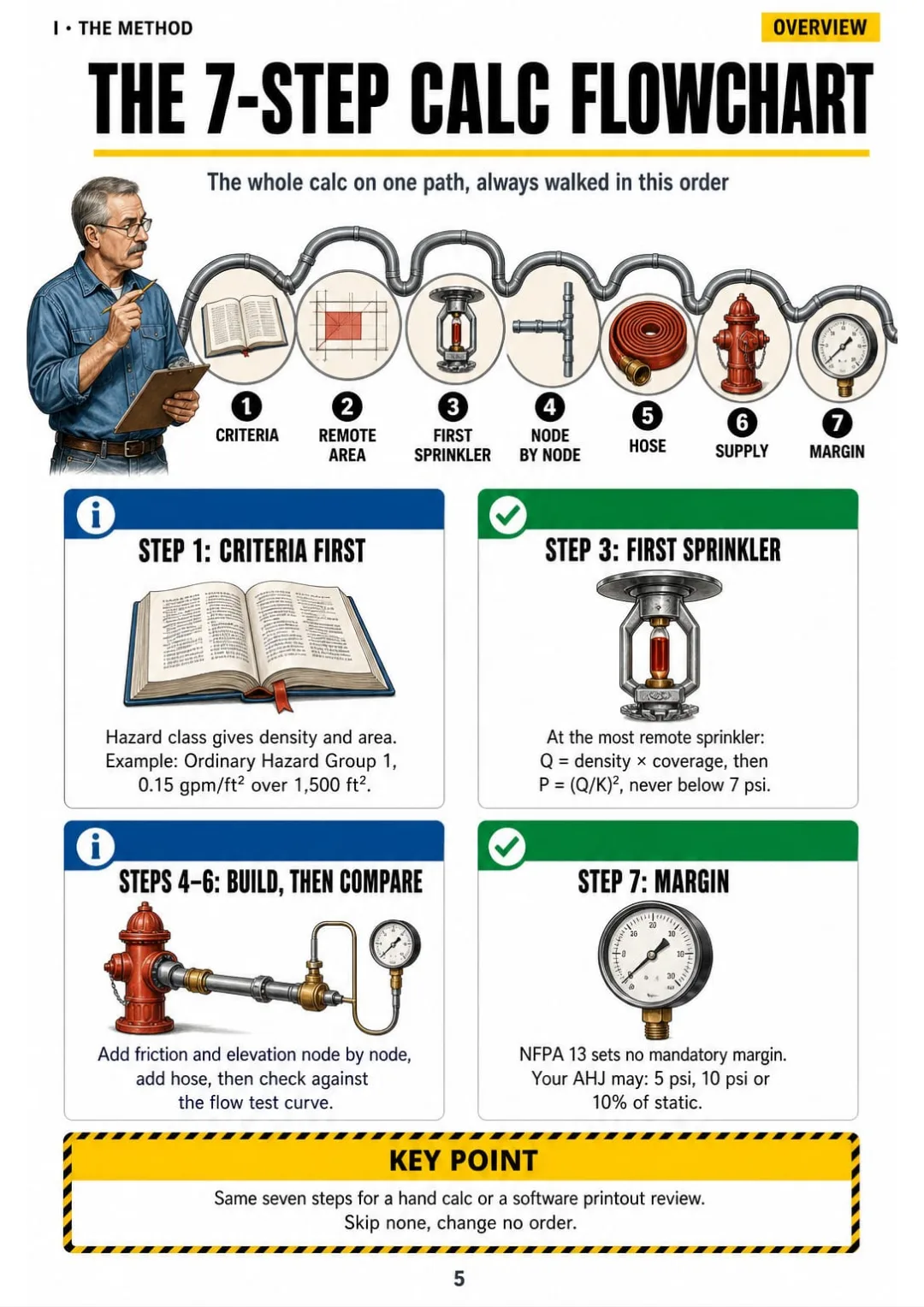
Criteria → remote area → first sprinkler → node by node → hose → supply → margin.
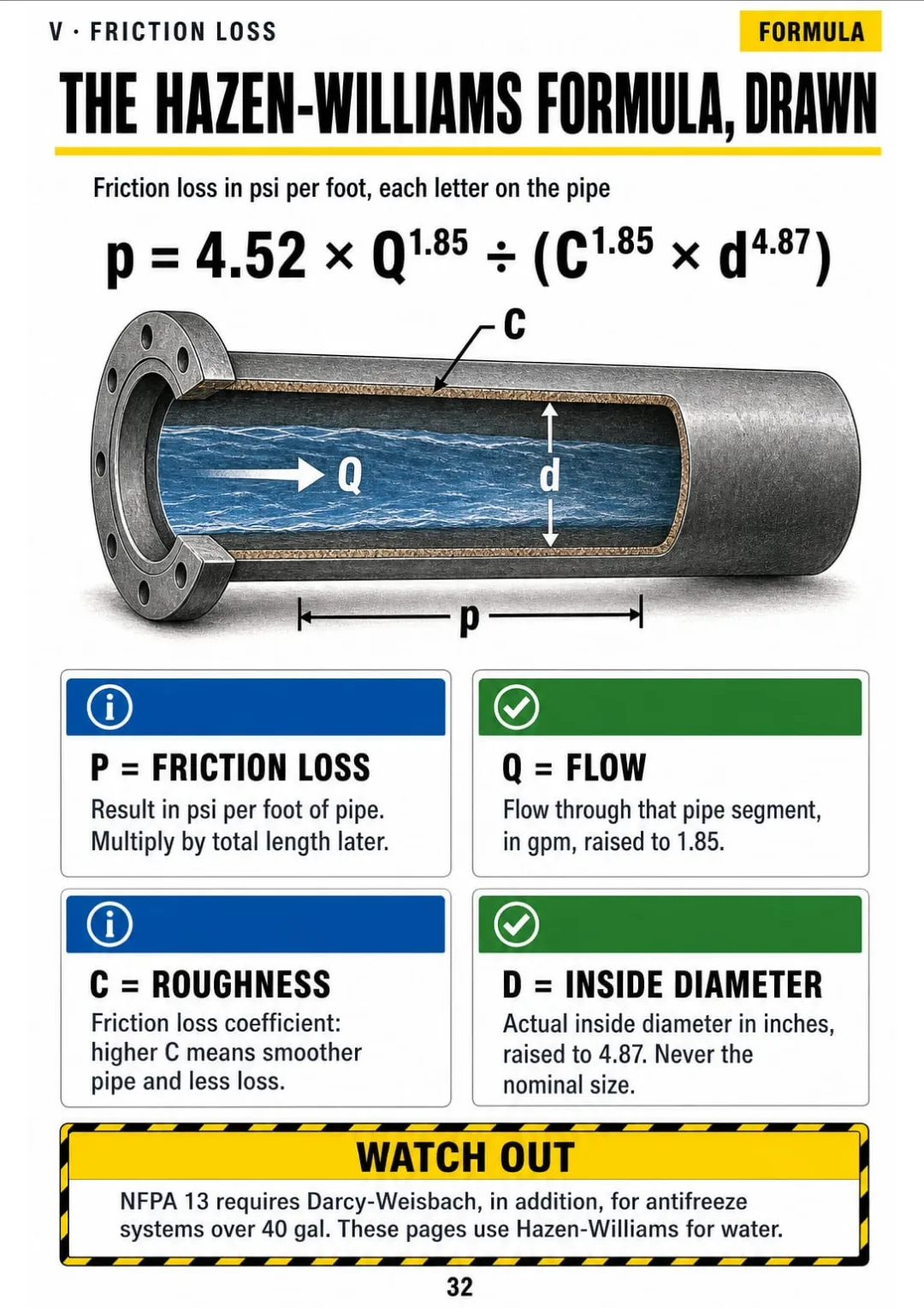
p = 4.52 × Q^1.85 ÷ (C^1.85 × d^4.87), in psi per foot.
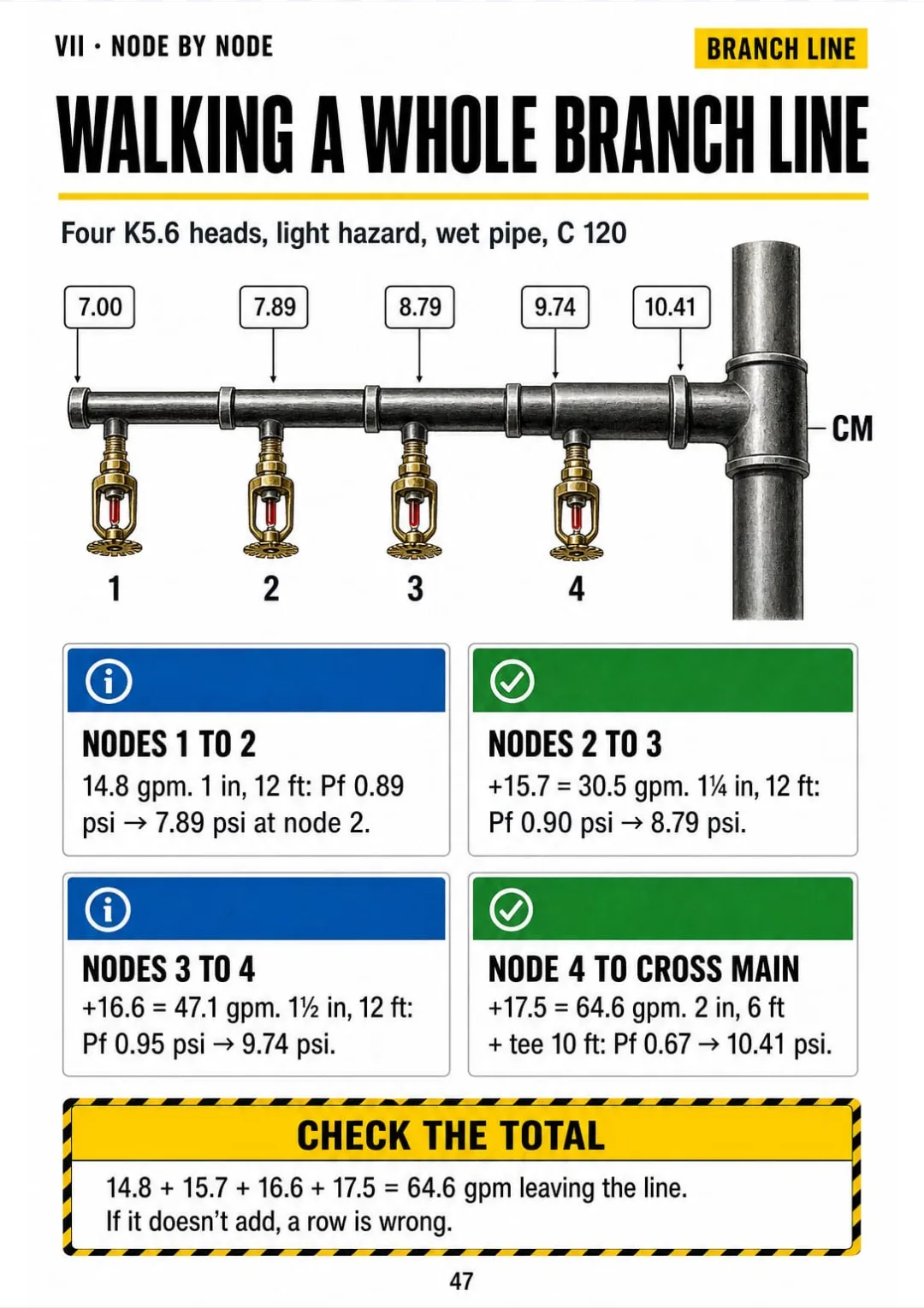
Four K5.6 heads from 7.00 psi: the line delivers 64.6 gpm at 10.41 psi to the cross main.
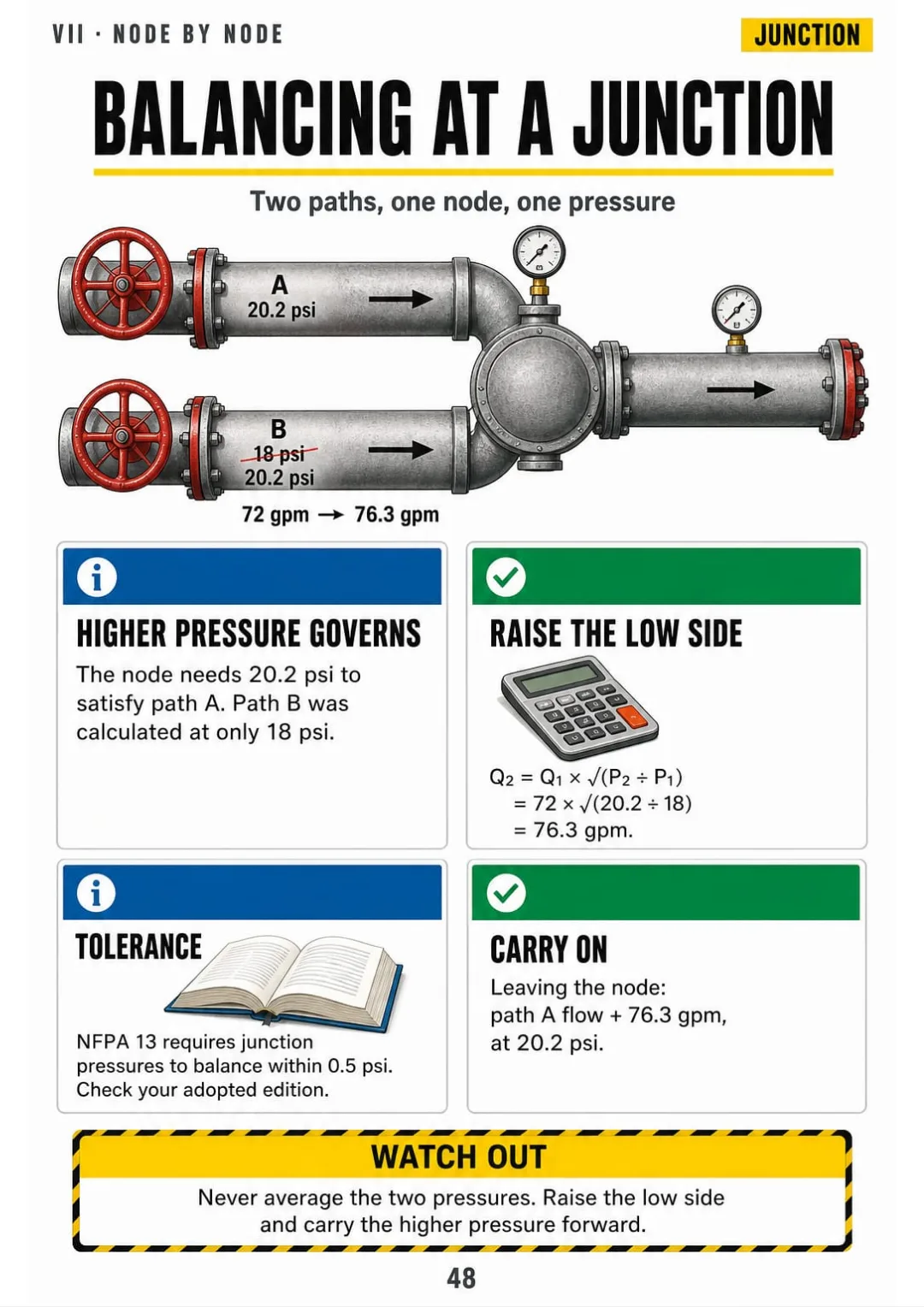
Low path corrected: 72 gpm at 18 psi becomes 76.3 gpm at 20.2 psi.
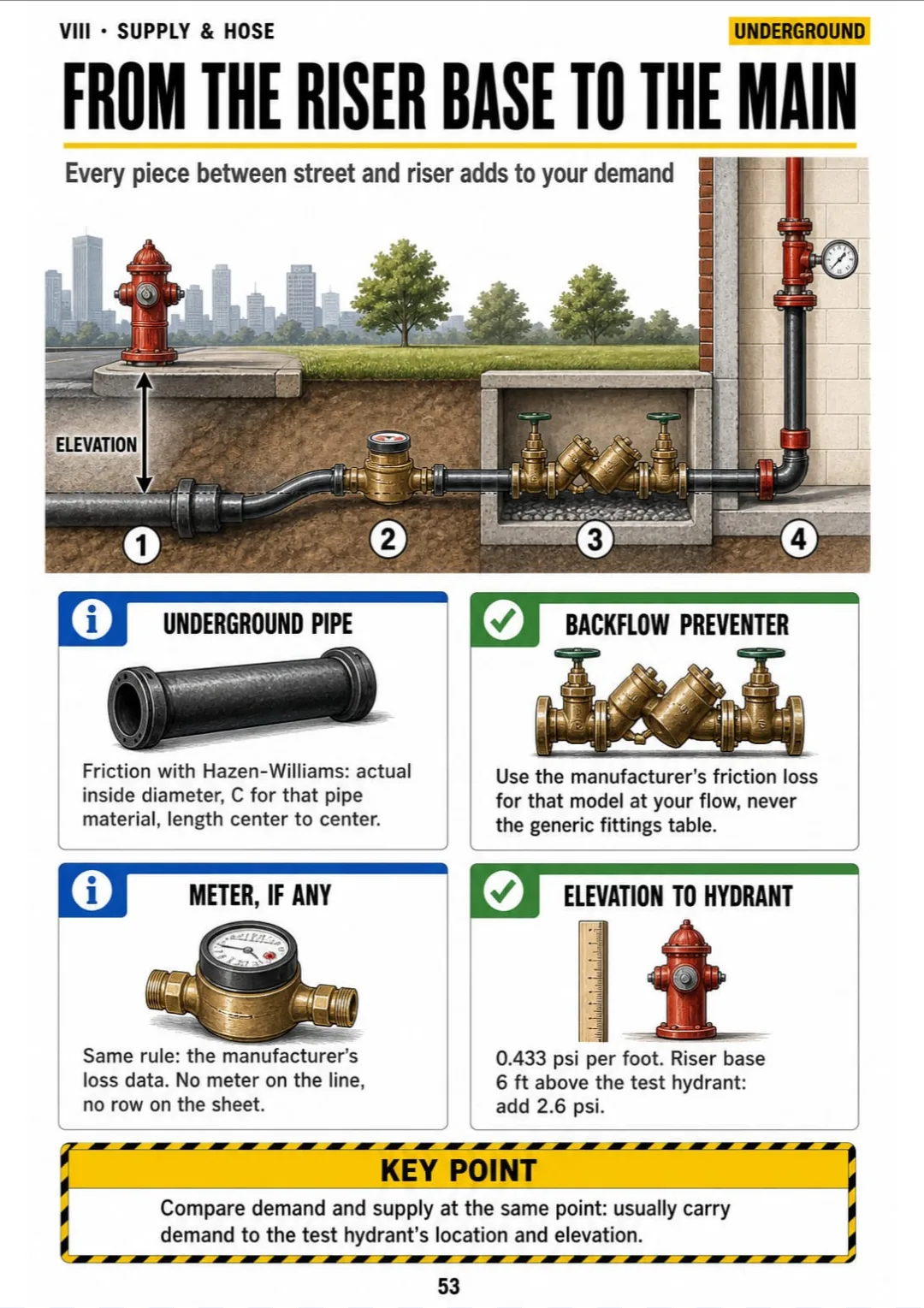
Underground, backflow, meter and elevation: four rows from the riser base to the test hydrant.
2½-in outlet, c 0.90, 16 psi pitot: about 671 gpm from that hydrant.
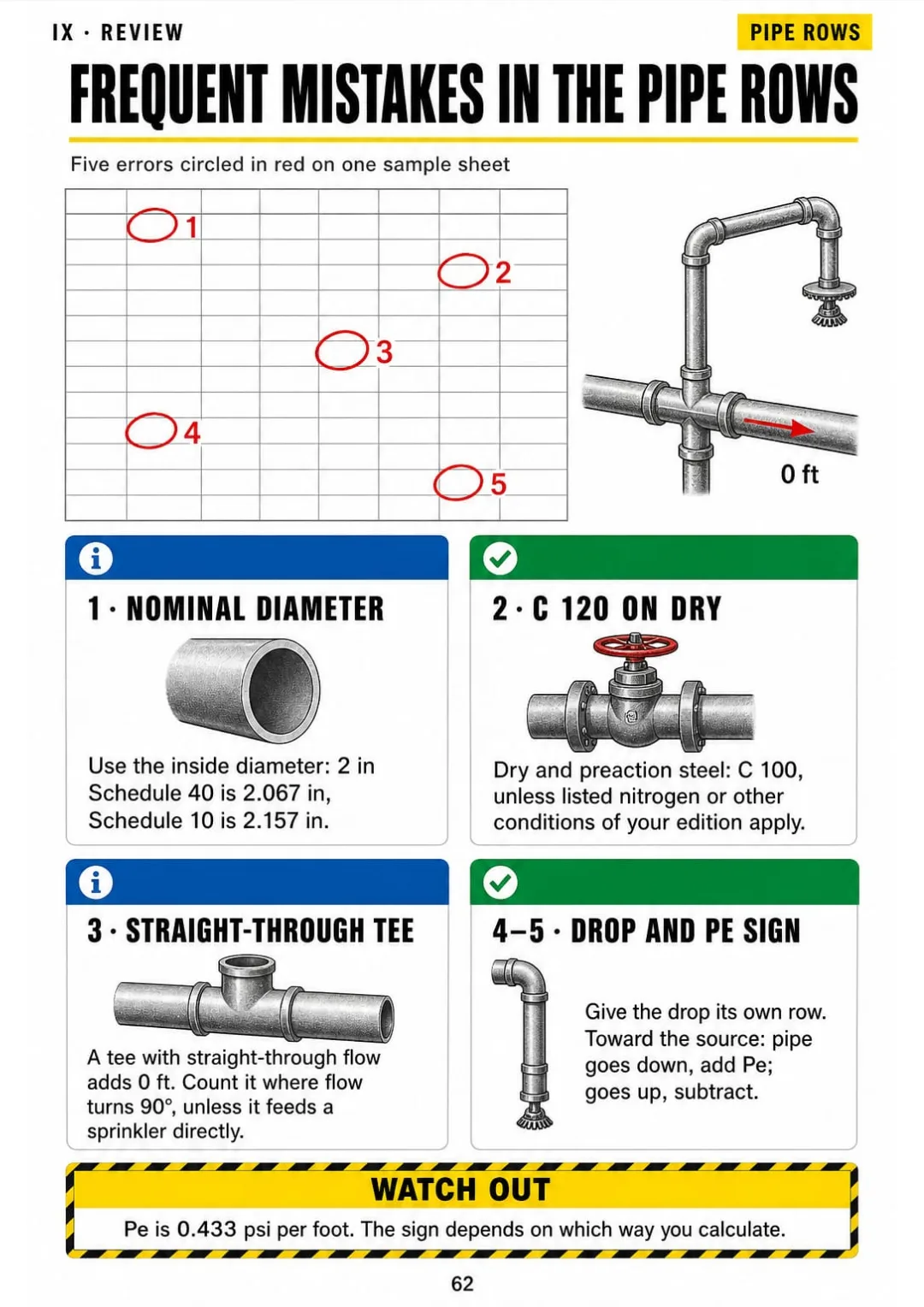
2 in Schedule 40 = 2.067 in ID: that number goes in the row, not 2.000.
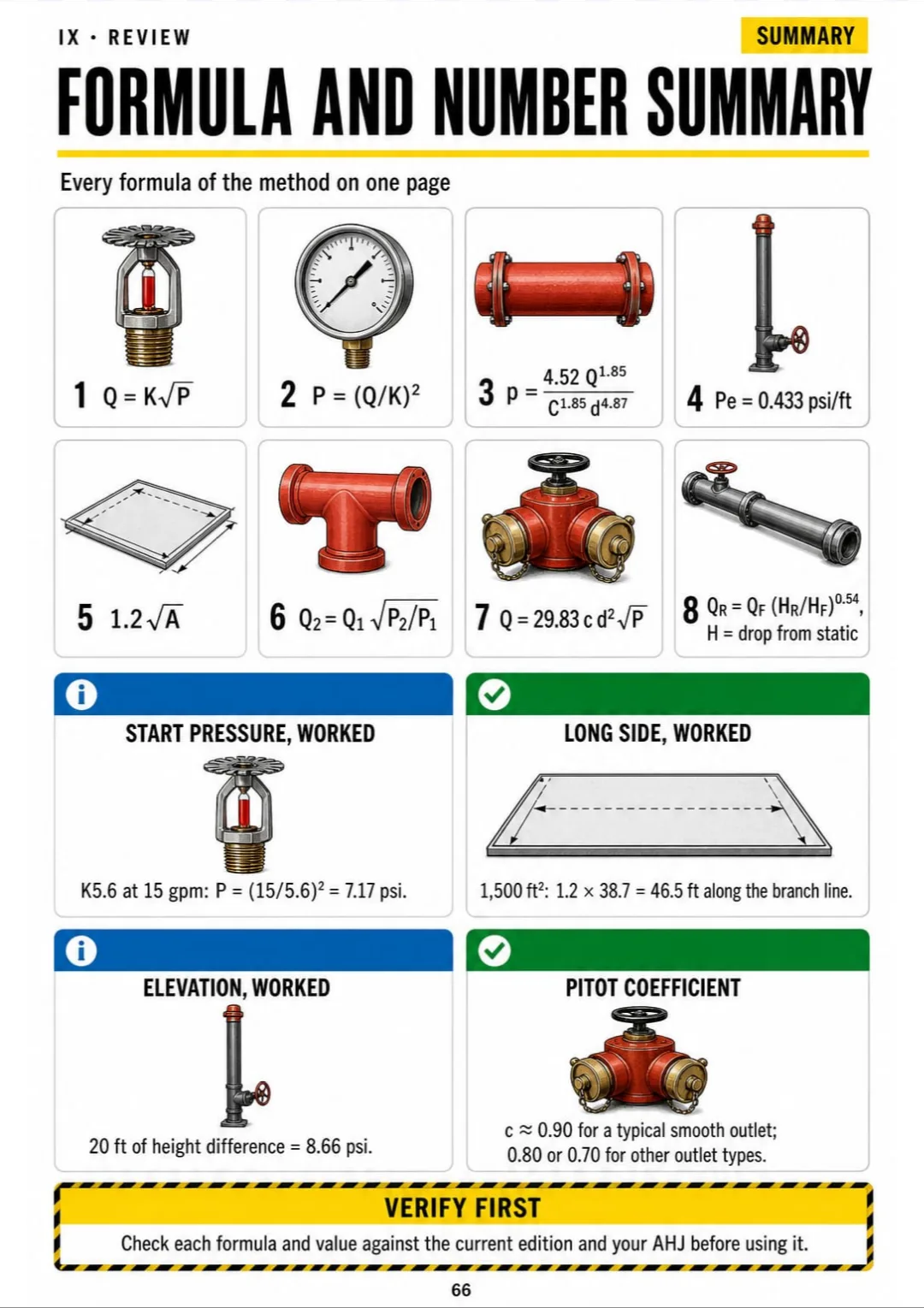
Q = K√P, Hazen-Williams, 0.433 psi/ft, 1.2√A, pitot and supply curve on one page.

Swipe to see more →

These are real pages from the book. The table of contents is the full one: 9 parts and 62 topics.

The Problem Isn't You. It's How It Was Explained to You.

You're looking at a branch line with four sprinklers on a calc sheet. The engineer asks how 7 psi at the end head turns into a different pressure at the cross main. The answer is on the sheet, but you can't walk through it out loud.

The standard and most manuals cover it in paragraphs: flow, friction, next head, next row. Every source walks the line in a different order, so the steps run together.

Four K5.6 heads from 7.00 psi: the line delivers 64.6 gpm at 10.41 psi to the cross main.

In this book, that branch line is one page. Four K-factor 5.6 heads drawn on the pipe, each with its pressure and flow, and the rows adding up head by head: from 7.00 psi at the end to 64.6 gpm at 10.41 psi at the cross main.

The same goes for the remote area and the 1.2√A rule, Hazen-Williams, fittings turned into feet of pipe, elevation at 0.433 psi per foot and the supply curve: each one has its own page.

You see the line build up row by row. You check the next calc sheet without going back to the standard for every line.

COMPARE FOR YOURSELF

Same Topic, Two Ways to Study It

THIS
  • The manual: line after line of text
  • Friction loss explained only in words
  • You sit down to review a calc still unsure
To find the pressure lost along each length of pipe, you start from the flow in that section, the roughness coefficient assigned to the pipe material and the real inside diameter, not the nominal size. The flow is raised to one exponent, the diameter to another, a constant is applied, and the loss you get per foot is multiplied by the total length of the section, including the equivalent length of every fitting, before you move to the next node and repeat the whole process with the new accumulated flow.
FOR THIS
  • Hazen-Williams in one drawing
  • Q, C and inside diameter in one box
  • You see it and you get it
p = 4.52 × Q^1.85 ÷ (C^1.85 × d^4.87), in psi per foot.
CONTENTS

Take a Look at the 9 Parts and 62 Topics

The method, design criteria, the remote area, the first sprinkler, friction loss, fittings and elevation, node by node, supply and margin, and the review checklist: 66 pages, all illustrated

IThe Method on One Page · pp. 5-10
  1. The 7-step calc flowchart
  2. Demand vs. supply: the only question
  3. US units you'll use on every line
  4. What a node is (and how to number them)
  5. Reading a calc sheet column by column
  6. Why do it by hand if you have software
IIDesign Criteria · pp. 11-18
  1. Occupancy hazard classes
  2. Density and area: two numbers, one choice
  3. Reading the density/area curve
  4. Area increase for dry and double-interlock systems
  5. Sloped ceilings: another 30%
  6. Quick-response reduction
  7. Room design method
  8. Hose stream allowance and duration
IIIThe Remote Area · pp. 19-24
  1. What 'hydraulically most remote' really means
  2. The 1.2√A rule for the long side
  3. How many sprinklers are in the area
  4. Sprinklers per branch line
  5. Placing the area on the plan
  6. Checking a remote area someone else drew
IVThe First Sprinkler · pp. 25-30
  1. K-factor: what the number means
  2. Q = K√P and its flip P = (Q/K)²
  3. Minimum flow from density × coverage
  4. The 7 psi floor
  5. Coverage area: S × L
  6. Listed sprinklers with their own rules
VFriction Loss in Pipe · pp. 31-38
  1. Why water loses pressure in pipe
  2. The Hazen-Williams formula, drawn
  3. Inside diameter, not nominal size
  4. C-factor by pipe and system
  5. Friction per foot, worked
  6. Doubling the flow is not double the loss
  7. Velocity pressure: when to use it
  8. Pipe length: center to center
VIFittings and Elevation · pp. 39-44
  1. Fittings become feet of pipe
  2. Which fittings count
  3. Equivalent length table, by C-factor
  4. Valves and devices: use the manufacturer
  5. Elevation: 0.433 psi per foot
  6. Pe sign: up is plus, down is minus
VIINode by Node · pp. 45-52
  1. The row of the first node
  2. The second sprinkler flows more
  3. Walking a whole branch line
  4. Balancing at a junction
  5. The K-factor of a whole branch line
  6. Along the cross main
  7. Down the riser to the base
  8. Gridded and looped systems: what changes
VIIISupply, Hose and Margin · pp. 53-59
  1. From the riser base to the city main
  2. Adding the hose stream at the right node
  3. The flow test: static, residual, flow
  4. Plotting the supply curve on 1.85 paper
  5. Reading pressure available at your flow
  6. Safety margin: who sets it
  7. When it fails: the fixes in order
IXReview Checklist and Frequent Mistakes · pp. 60-66
  1. Line-by-line review checklist
  2. Frequent mistakes in the criteria
  3. Frequent mistakes in the pipe rows
  4. Frequent mistakes with the supply
  5. Explaining a calc out loud
  6. Blank calc sheet to print
  7. Formula and number summary

One Page, One Topic, All Clear

Think of it this way:

A plans examiner sends your submittal back with one note circled: the flows at a junction don't balance. You need an answer before the end of the day.

You open the page on balancing at a junction and see the two paths drawn side by side: the low path at 72 gpm and 18 psi, corrected up to 76.3 gpm at 20.2 psi, with the square-root step in a box.

Underground, backflow, meter and elevation: four rows from the riser base to the test hydrant.

Same with the remote area, the 7 psi floor, elevation at 0.433 psi per foot, the flow test and the supply curve on 1.85 paper: each one on its own page.

Sprinkler Hydraulics Illustrated is 9 parts and 62 topics, all drawn, with a line-by-line review checklist, a blank calc sheet to print and a formula summary at the end.

What you see drawn, you don't have to memorize.

What's Inside Sprinkler Hydraulics Illustrated:

Ipp. 5-10

The Method on One Page

The 7-step flowchart, demand vs. supply, the US units on every line, how to number nodes, reading a calc sheet column by column and why to do it by hand.

IIpp. 11-18

Design Criteria

Hazard classes, density and area, reading the curve, area increases for dry systems and sloped ceilings, the quick-response reduction, the room design method and hose allowance.

IIIpp. 19-24

The Remote Area

What hydraulically most remote means, the 1.2√A rule, how many sprinklers go in the area and per branch line, and how to check an area someone else drew.

IVpp. 25-30

The First Sprinkler

What the K-factor means, Q = K√P and its flip, minimum flow from density × coverage, the 7 psi floor, S × L and listed sprinklers with their own rules.

Vpp. 31-38

Friction Loss in Pipe

Why water loses pressure, Hazen-Williams drawn, inside diameter vs. nominal, C-factors, friction per foot worked out, velocity pressure and center-to-center lengths.

VIpp. 39-44

Fittings and Elevation

Fittings as feet of pipe, which ones count, equivalent lengths by C-factor, valves from the manufacturer's data and elevation at 0.433 psi per foot, with the sign.

VIIpp. 45-52

Node by Node

The first row, why the second head flows more, a whole branch line, balancing at a junction, the branch line K-factor, the cross main, the riser and gridded systems.

VIIIpp. 53-59

Supply, Hose and Margin

Riser base to city main, adding the hose stream at the right node, the flow test, plotting on 1.85 paper, pressure available, safety margin and the fixes when it fails.

IXpp. 60-66

Review Checklist and Frequent Mistakes

The line-by-line review checklist, frequent mistakes in criteria, pipe rows and supply, explaining a calc out loud, a blank calc sheet and the formula summary.

At the end of the book: A line-by-line review checklist, a blank calc sheet to print and every formula and number on one summary page.
Plus: 2 Free Books

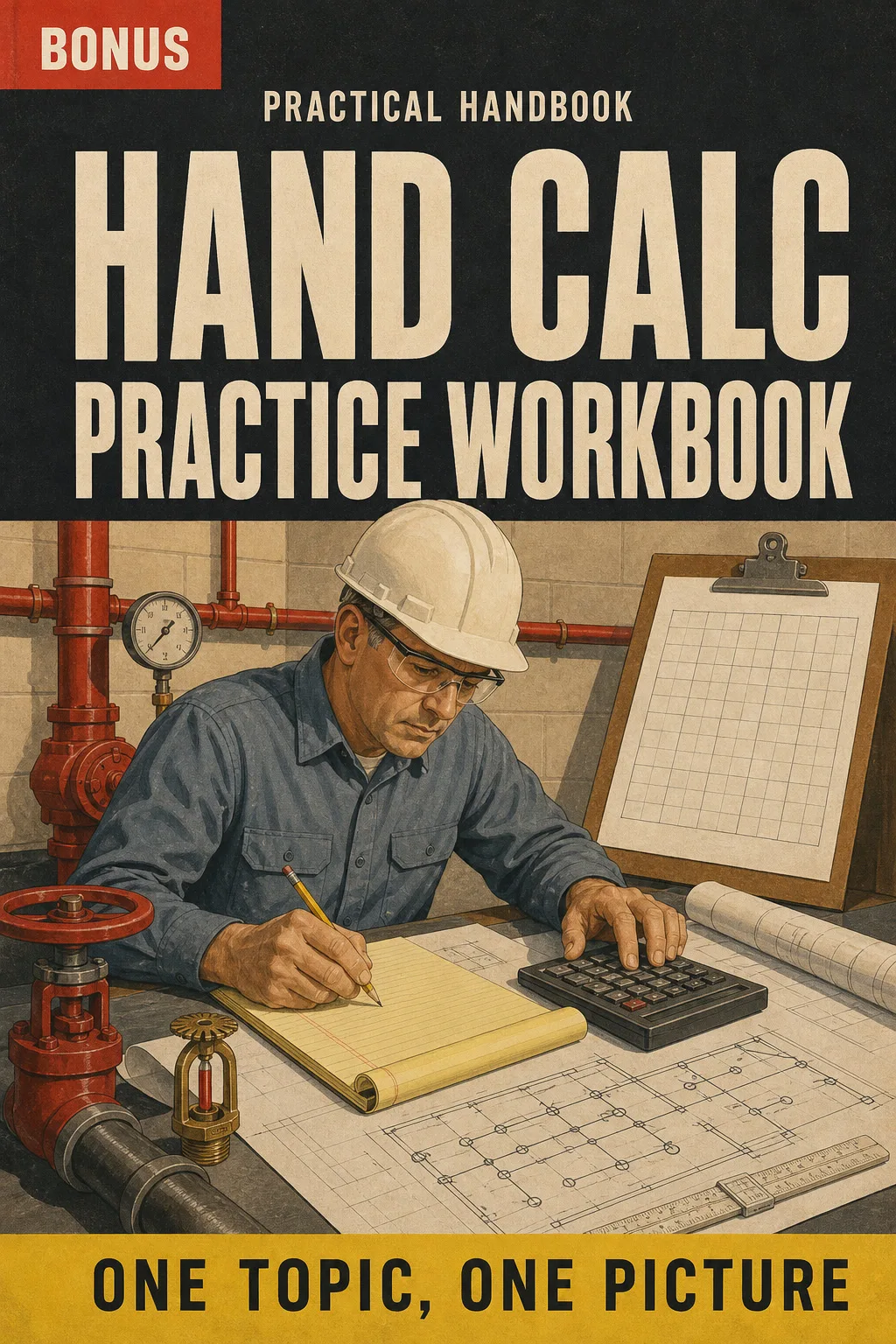
Hand Calc Practice Workbook

BONUS 1: «Hand Calc Practice Workbook»

Value on its own: US$ 17.90

Practice problems on blank calculation tables, from the first sprinkler to the base of the riser, with every answer worked out so you can check yourself step by step.

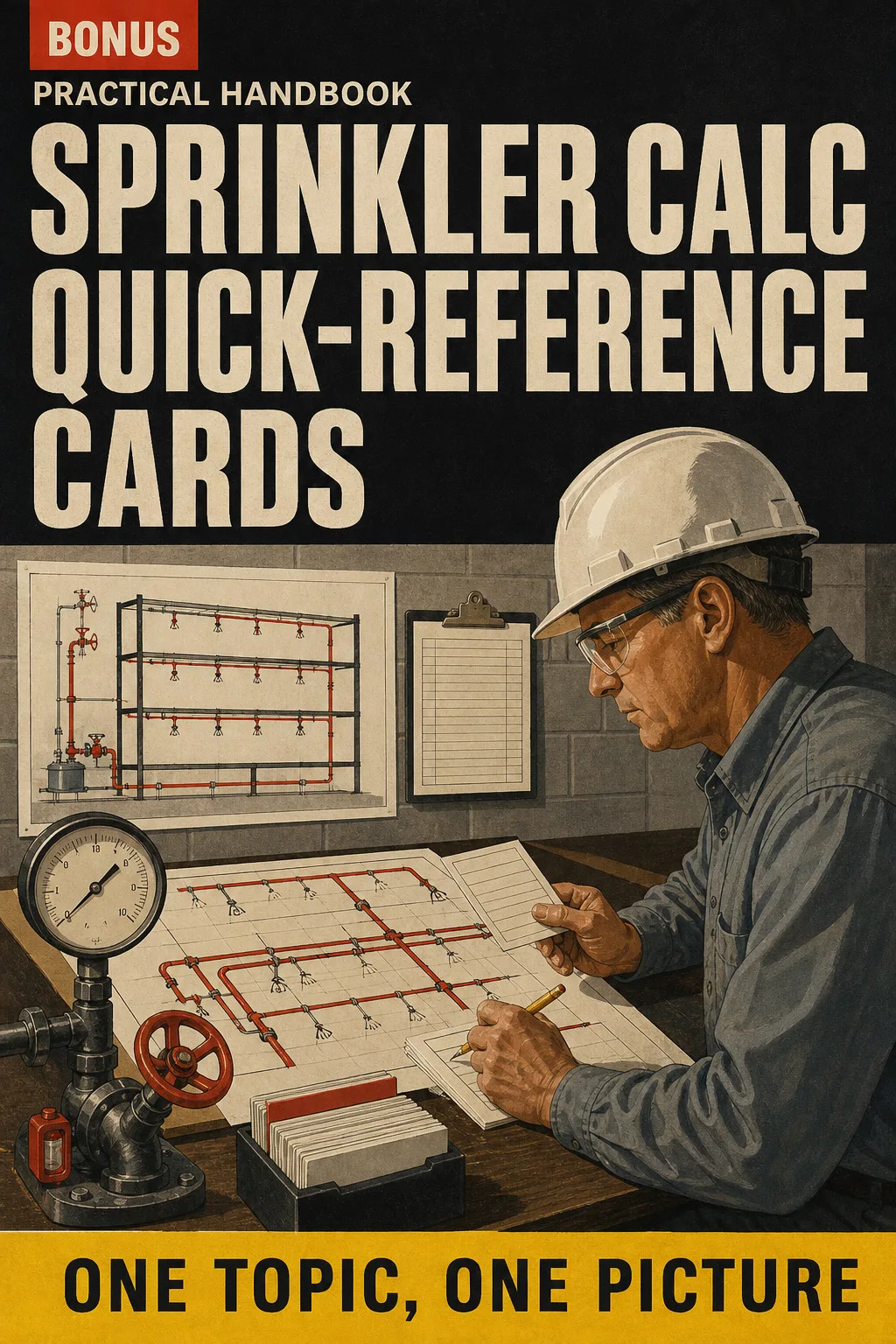
Sprinkler Calc Quick-Reference Cards

BONUS 2: «Sprinkler Calc Quick-Reference Cards»

Value on its own: US$ 14.90

The formulas, the order of the steps and the most frequent mistakes on printable cards to keep next to your desk while you design or review.

Sprinkler Hydraulics Illustrated with 2 Free Books

  • Sprinkler Hydraulics Illustrated: 66 illustrated pagesUS$ 63
  • BONUS 1: Hand Calc Practice WorkbookUS$ 17.90
  • BONUS 2: Sprinkler Calc Quick-Reference CardsUS$ 14.90
  • High-resolution PDF to printIncluded
Total value US$ 95.80
YOUR PRICE:
US$ 27
You save US$ 68.80
YES, I WANT SPRINKLER HYDRAULICS ILLUSTRATED FOR US$ 27

📄 This is a digital PDF book sent to your email: nothing is printed or shipped.

Secure purchaseEncrypted payment30-day guarantee

PDF by email: We email you Sprinkler Hydraulics Illustrated as a PDF, together with the two free books. It's a single payment: no installments, no extra charges.

Who This Book Is For

You're moving from fitter to layout

You're moving from fitter to layout

You know pipe from years in the field, and maybe a NICET layout level is next. Here the calc is drawn in the same order every time, so it finally connects to what you built.

You design with software every day

You design with software every day

You see what every line of the sheet means, node by node, so you can check the output and explain it to the engineer or the client.

You review calcs as a plans examiner

You review calcs as a plans examiner

A checklist and frequent mistakes to review any submittal line by line, from the remote area to the margin against the supply.

Everything You Get Today

US$ 95.80US$ 27
YES, I WANT SPRINKLER HYDRAULICS ILLUSTRATED FOR US$ 27

📄 This is a digital PDF book sent to your email: nothing is printed or shipped.

30DAYS
GUARANTEE

30-Day Guarantee

Try Sprinkler Hydraulics Illustrated for 30 days, bonus books included.

We refund everything if the file won't open, if the book isn't what you see here, if you were charged twice or if the email doesn't arrive. Just email us.

You pay once. No subscriptions.

Frequently Asked Questions

Is it for me if I already use calc software every day?

Yes. It isn't a beginner's book. The software gives you the answer; this shows what every line of the sheet means, node by node, so you can check the output, catch a wrong input and explain it to the engineer or the reviewer. Everything is in US units: gpm, psi and feet.

Where does the content come from?

It's based on NFPA 13 for sprinkler systems and NFPA 291 for flow testing. Example values are for illustration only, and every criterion is marked so you can check it against the edition your AHJ adopts and the manufacturer's data.

Is this official material?

No. It's an independent illustrated study and reference book. It is not affiliated with or endorsed by NFPA or any authority having jurisdiction, and it doesn't reproduce the standard's tables.

Does it replace training or the engineer of record?

No. It helps you understand, build and review a hand calc. Training, the current standard, the engineer of record and the approval of your AHJ still apply.

Are the practice problems taken from any official test?

No. The practice problems and worked examples were written for this book, to train the method step by step. If you're working toward a NICET Water-Based Systems Layout level, it helps you study the hydraulic calc part; it doesn't replace that exam's own references and it isn't affiliated with NICET.

When and how do I get it?

The book and the 2 bonus books arrive as PDFs by email, at the address you enter at checkout.

Do I have to pay every month?

No. It's a one-time payment. No subscription.

Can I have it on paper?

Yes. It's a PDF you can print at home or at a print shop and keep on your desk, including the blank calc sheet.

How does the refund work?

You have 30 days. We refund everything if the file won't open, if the book isn't what you see on this page, if you were charged twice or if the email doesn't arrive: just email us.

Before You Close This Page

No more rereading the standard without it sticking.

A whole branch line, drawn on one page. You see it and it clicks.

You sit down to design or review knowing where every number comes from.

Drawings make studying faster.

The book is right below.

One-time payment: US$ 27 · Guarantee: 30 days · PDF by email

YES, I WANT SPRINKLER HYDRAULICS ILLUSTRATED FOR US$ 27

📄 This is a digital PDF book sent to your email: nothing is printed or shipped.